
Review · BARCELONA
Barcelona: 2.5-Hour Gaudí Segway Tour
Barcelona’s Gaudí architecture is spread across wide boulevards and several neighborhoods, so a Segway can save your feet while helping you see a lot in 2.5 hours. The route links Sagrada Familia, Passeig de Gràcia, Arc de Triomf, and Gràcia instead of keeping you in one small sightseeing zone.
I like the careful training and the small groups of two to six people per guide. I also like the mix of famous façades and less familiar modernist buildings, including Casa Amatller and Casa de les Punxes. The main drawback is that this is an exterior sightseeing tour, not a ticketed visit inside Sagrada Familia or the other buildings, and Segway riding is not suitable for everyone.
Key points to know before you book
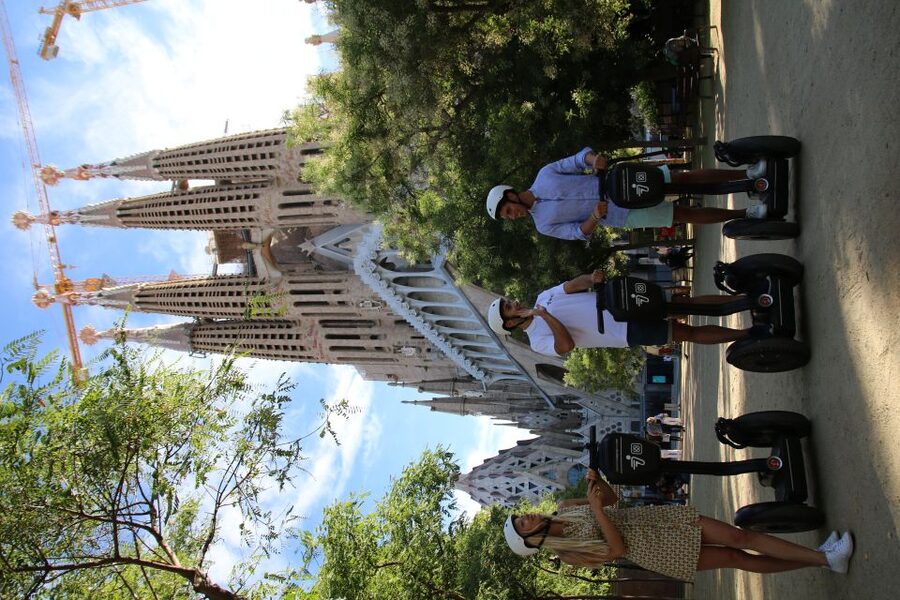
- Sagrada Familia is the star stop: You get time for photos and a guided look at Gaudí’s unfinished church, but no interior admission is included.
- Passeig de Gràcia packs in modernist architecture: Casa Milà, Casa Batlló, and Casa Amatller sit along one of Barcelona’s best-known boulevards.
- The route reaches beyond Gaudí: You’ll also see work by Josep Puig i Cadafalch and Lluís Domènech i Montaner.
- Training comes first: A guide teaches you to use the Segway and keeps the group moving safely through city streets.
- Gràcia adds a local neighborhood feel: Plaza de la Vila de Gràcia offers a change from the grand avenues and major monuments.
- The tour suits active visitors age 16 and up: Riders must meet the stated height, weight, and mobility requirements.
Why a Segway works well for this Barcelona route
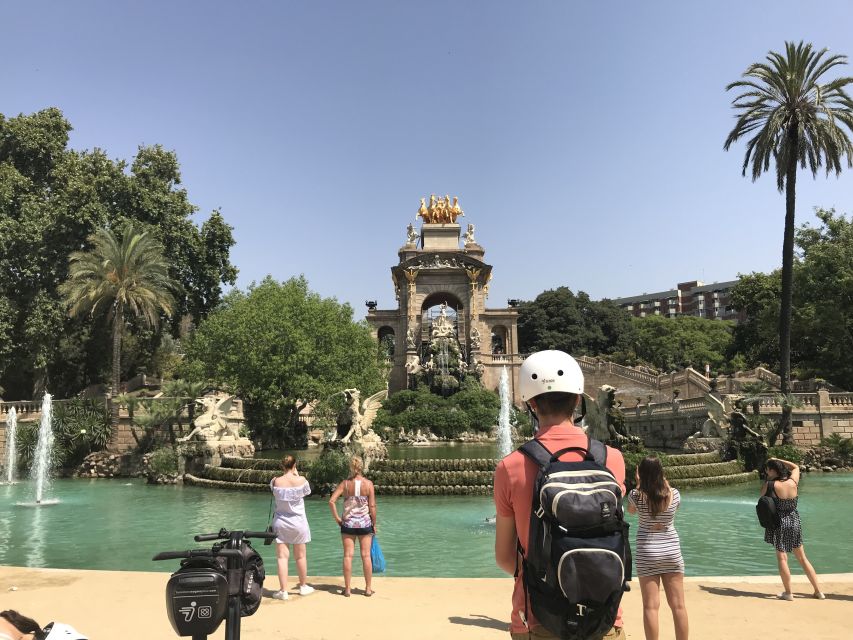
The best reason to choose this tour is distance. Barcelona’s modernist sights are not all gathered around one plaza. Arc de Triomf, Passeig de Gràcia, Sagrada Familia, and Gràcia form a broad route, and walking between them takes time that could otherwise go toward looking up at the buildings.
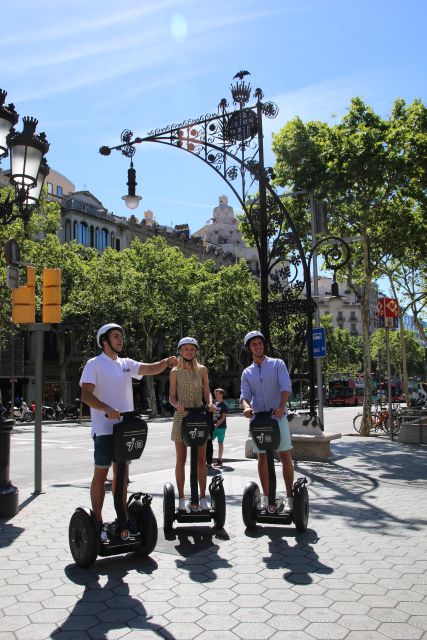
A Segway also gives you a raised view above much of the street traffic. You can cover more ground than on foot, then stop for explanations and photos. The route begins at Passeig de Lluís Companys, close to Arc de Triomf, and returns there at the end, which keeps the tour easy to plan around.
The vehicle is a Segway i2, with a helmet, safety equipment, insurance, and instruction included. If you have never used one, that should not put you off automatically. The training is an important part of the experience, and the guide checks that you can control the machine before taking the group into the city.
Still, this is not a passive ride. You stand for much of the 2.5 hours, make balance and steering movements, and need to manage motions similar to climbing and descending stairs. If your knees, balance, or mobility are limited, a conventional walking or bus tour may be a better choice.
Other segway rides we rate around Barcelona
- Barcelona Segway Tour
★ 5.0 · 680 reviews - Barcelona Segway Tour
★ 4.7 · 630 reviews - Barcelona: City Highlights Guided Segway Tour
★ 4.9 · 624 reviews
Arc de Triomf gives the tour a strong start
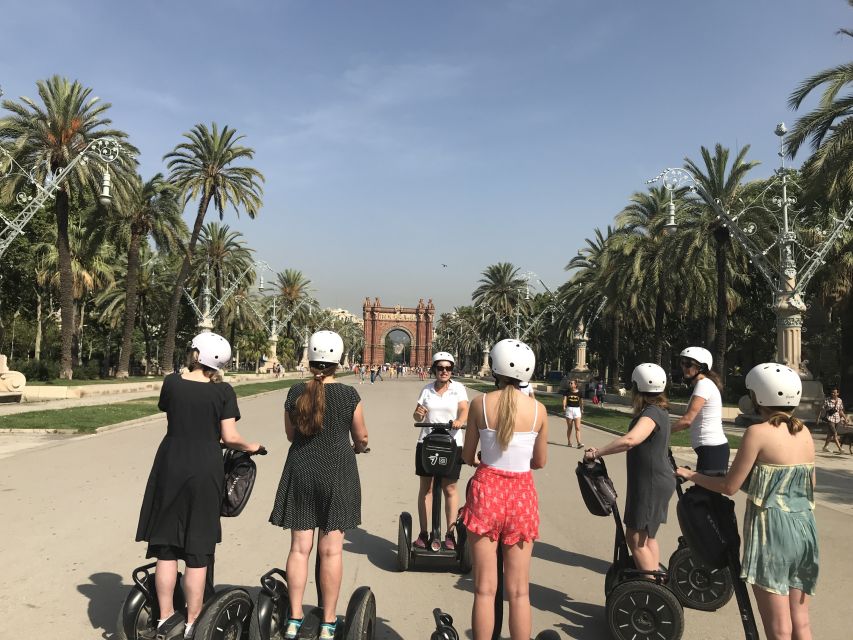
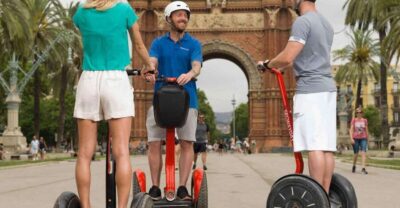
The meeting point is the activity provider’s office at Passeig de Lluís Companys 10. From there, the tour begins beside Arc de Triomf, the red-brick gateway built for the 1888 Barcelona Universal Exposition.
This is a useful first stop because the broad avenue gives you room to get comfortable on the Segway. The guide provides the safety briefing and basic instruction before the group sets off. The opening stretch also gives you a clear sense of Barcelona’s wide urban planning, a useful contrast to the narrower streets you encounter later.
Your guide controls the pace and route. Small groups contain two to six people per guide, while larger bookings are split between several guides. That matters in a city where pedestrians, bicycles, cars, and scooters share busy streets. Guides named in recent bookings include Alex, Edwin, Maria, Daniel, Stephan, Fabio, Virginia, David, and Nico, though your assigned guide will depend on the date and language.
Passeig de Gràcia turns architecture into a street show
The ride continues toward Passeig de Gràcia, Barcelona’s grand modernist boulevard. Here, the buildings are not just isolated monuments. Their façades compete for attention along a major shopping street, giving you a close look at how Barcelona’s wealthy families commissioned daring new homes around the turn of the 20th century.
Casa Milà, known as La Pedrera
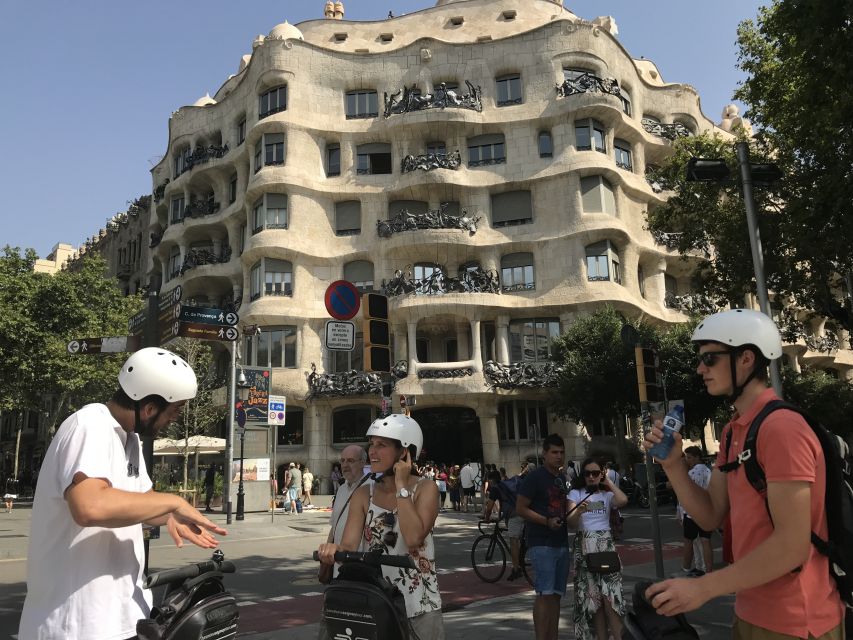
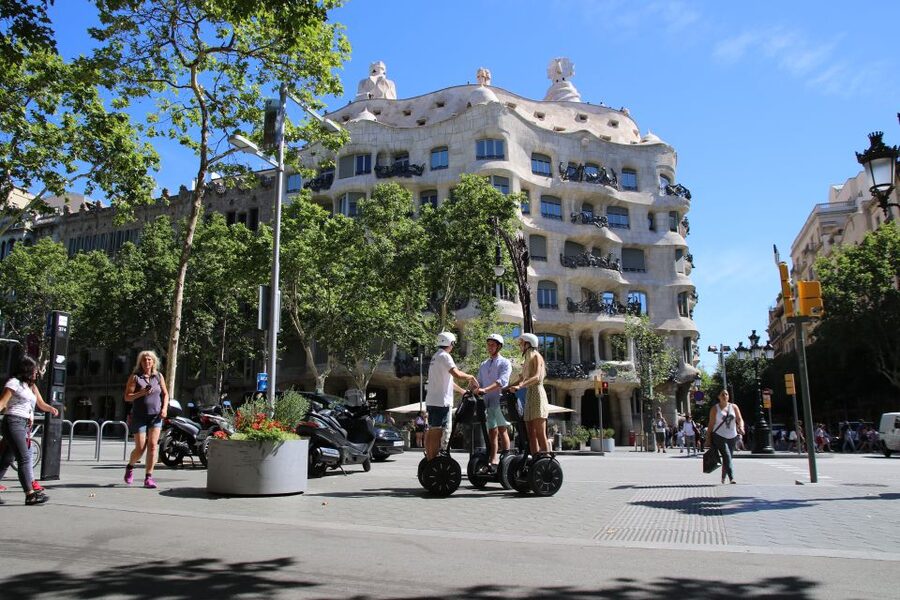
Casa Milà is one of Gaudí’s most recognizable works. Its rolling stone façade and unusual iron balconies give it the nickname La Pedrera, or the stone quarry. The tour allows about 10 minutes for this stop, including a guided explanation and time to look closely.
I consider this one of the most rewarding exterior stops. The building does not rely on a neat, symmetrical face. Its rough curves and sculpted stone make it feel almost geological, and you can appreciate that effect quickly from the street.
The limitation is simple: the tour does not include entry. You will not visit the famous roof or interior spaces on this outing. If La Pedrera is a personal priority, plan a separate timed admission.
Same streets, another route to glide:
- Barcelona: 2-Hour City Sights Guided Segway Tour
★ 4.9 · 610 reviews - Barcelona: Guided Segway Tour
★ 4.8 · 412 reviews - Barcelona Guided Tour by Segway
★ 5.0 · 374 reviews - Barcelona: City and Seafront Guided Segway Tour
★ 4.9 · 317 reviews
Casa Batlló
A short ride brings you to Casa Batlló, another Gaudí creation on Passeig de Gràcia. The façade is covered with color, curved shapes, and details that reward a slow look. The guided stop helps you understand the design rather than simply take a quick photograph.
Casa Batlló is close to Casa Amatller, so this stretch gives you a useful comparison. Gaudí’s building has an animated, almost dreamlike quality, while the neighboring Casa Amatller has a more ordered appearance shaped by another major modernist architect.
Again, treat this as an exterior visit. The itinerary lists sightseeing and guided viewing, not admission inside Casa Batlló. That makes the tour a strong introduction, but not a replacement for an architectural visit.
Casa Amatller
Casa Amatller was commissioned in 1898 by Antoni Amatller, a wealthy chocolate manufacturer. Its stepped roofline and decorative façade make it easy to identify beside Casa Batlló.
This is exactly the kind of detail that improves the tour. You are not shown only the two most famous Gaudí buildings. You also learn how Barcelona’s modernist movement included several architects and wealthy patrons who wanted their homes to make a public statement.
Casa de les Punxes broadens the modernist picture
Casa de les Punxes, officially associated with the work of Josep Puig i Cadafalch, looks like a medieval castle adapted for an urban avenue. Its pointed roof sections and towers give it a very different character from Gaudí’s softer, more fluid forms.
The stop helps answer an important question: what does Catalan Modernism mean beyond Gaudí? Barcelona’s architectural identity was shaped by several gifted designers, and the tour gives you enough examples to notice those differences.
You will likely appreciate this stop most if you enjoy looking at details. It is not as instantly famous as Sagrada Familia, but it adds context and keeps the experience from becoming a simple checklist of Gaudí façades.
Sagrada Familia is the visual high point
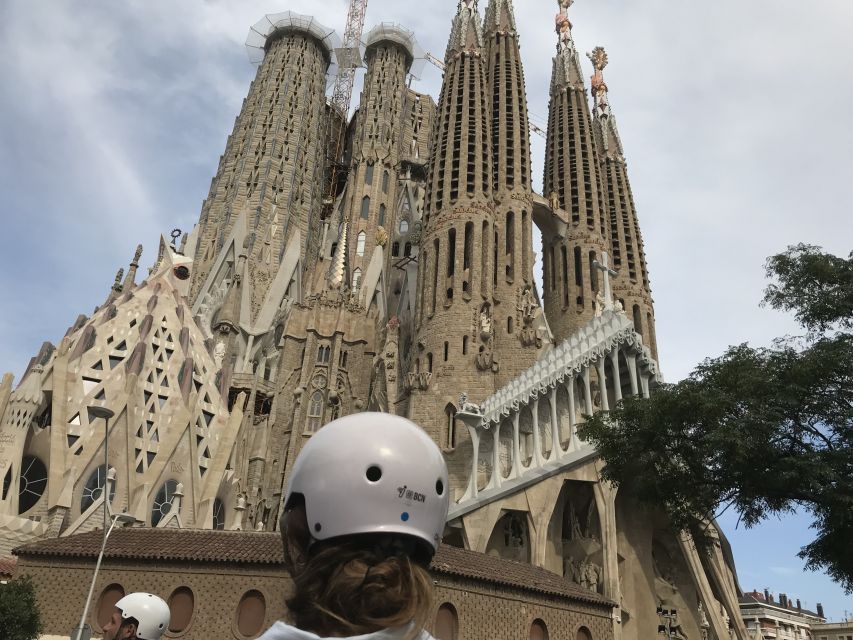
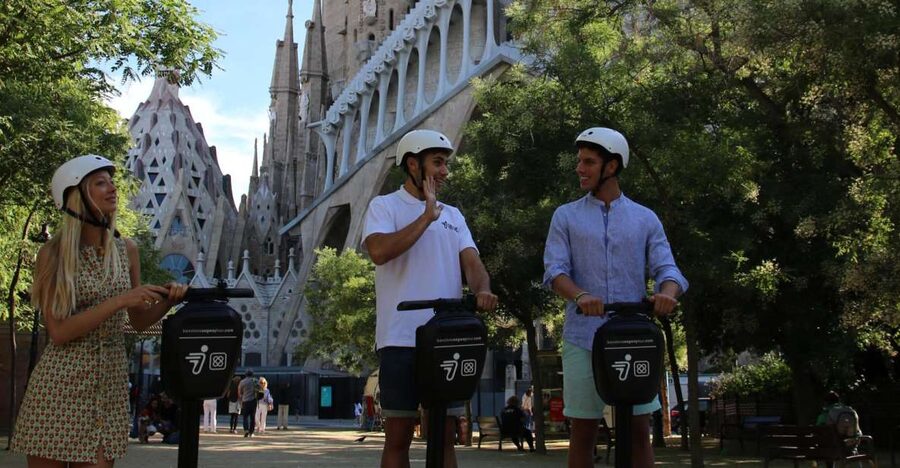
The route reaches the Sagrada Familia neighborhood for a photo stop, guided visit, sightseeing, and about 15 minutes of riding in the area. Even from outside, Gaudí’s church is difficult to mistake for anything else. Its towers, sculpted surfaces, and unfinished state make it one of Barcelona’s most unusual sights.
The guide can explain the building’s place in the city and point out details that are easy to miss when you first see it. You get free time for photographs, which is useful because the church is large and looks different from each side.
Keep your expectations clear. This tour does not include a ticket inside Sagrada Familia. The stop is best for orientation, exterior views, and deciding if you want to return for a longer visit. If you want the basilica interior, towers, or museum, book those separately and allow more time.
The church is also a practical reason to choose the Segway. It sits away from the starting point, yet the tour folds it into a broader route that includes several other districts. You see the building without giving up the rest of the morning or afternoon.
La Monumental adds a piece of Barcelona’s past
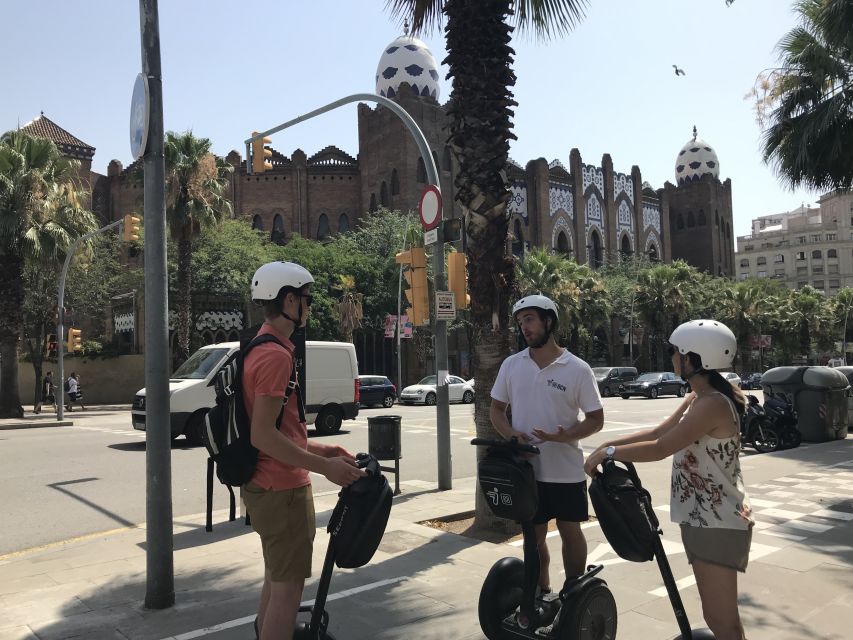
La Monumental is the former bullfighting arena included on the route. It was the last arena in Catalonia where bullfights took place before the Catalan parliament banned the practice.
This stop adds social and political context to the architecture. Barcelona’s story is not only Gaudí and polished boulevards. The city has also changed its public traditions and debated which customs belong in modern Catalonia.
The arena is viewed from outside during the tour, with a guided explanation and time for photos. It is a quick stop, but a worthwhile one because it gives the route a subject beyond design.
Gràcia feels smaller and more local
After the grand avenues and monumental buildings, the tour makes a quick escape into Gràcia. The destination is Plaza de la Vila de Gràcia, marked by its distinctive bell tower and former town hall, La Casa de la Vila de Gràcia.
Gràcia was established in the 17th century and remained an independent municipality until Barcelona annexed it in 1897. That past helps explain its different feel. Instead of the large blocks and formal boulevards of Eixample, you find lower buildings, small alleys, local shops, restaurants, and small art galleries.
The plaza is a good place to pause and notice the neighborhood scale. You are still in central Barcelona, but the setting feels less monumental and more connected to everyday city life. The tour does not spend hours wandering through Gràcia, so think of this as a useful sample rather than a full neighborhood visit.
If you like the area, return later on foot. A Segway is excellent for covering distance, but walking is better for browsing shop windows, stopping for food, and exploring side streets at your own pace.
The guide makes a bigger difference than the machine
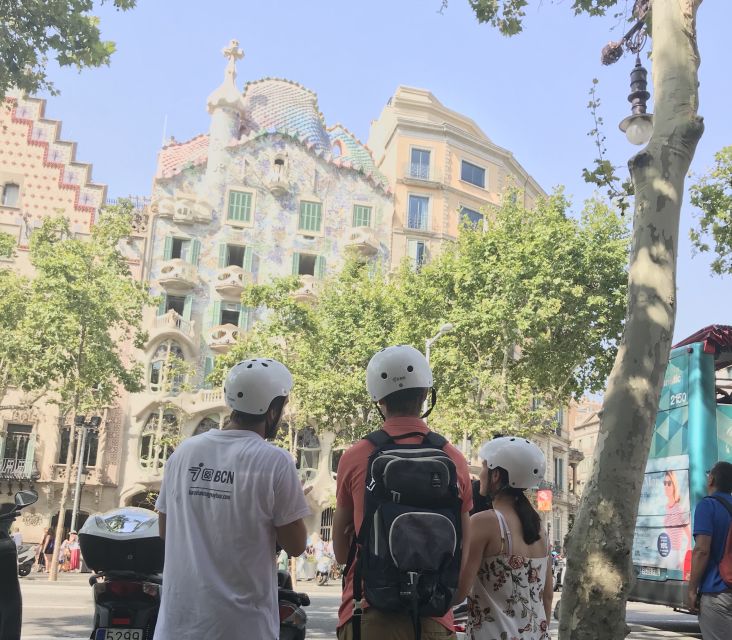
The Segway is the novelty, but the guide shapes the quality of the experience. A good guide must handle three jobs at once: explain architecture, teach safe riding, and keep the group together.
The strongest guide names connected to this experience include Alex, who has helped visitors with food and sightseeing ideas for the rest of their stay; Edwin, praised for steady instruction and a good pace; and Maria, who combines cultural background with careful attention to safety. Other guides, including Stephan, Fabio, Virginia, David, Nico, Daniel, and Natalia, have also led highly rated outings.
The languages offered are Dutch, English, French, German, Italian, Portuguese, Russian, and Spanish. When booking, select the language that lets you ask questions easily. This tour covers many buildings in a short time, so clear explanations matter.
A guide can also adjust the rhythm to the group within the safety limits. One outing may move quickly, while another may pause longer at a façade. If you want a more personal pace, private and small-group options are available.
Is $42 a fair price?
At $42 per person, the tour offers reasonable value if your priority is seeing a wide area with a guide. The price includes the Segway, helmet, training, safety equipment, insurance, one drink, and a 2.5-hour guided route.
You are paying mainly for transportation within the city and interpretation, not admission to major monuments. That distinction is important. A visitor who wants to enter Sagrada Familia, Casa Batlló, or La Pedrera will need separate tickets, so the total cost of a full architecture day will be higher.
For a short Barcelona visit, the value is stronger. You can cover Eixample, Gràcia, Arc de Triomf, Sagrada Familia, and La Monumental in one outing, then return to the places that deserve more time. For a visitor who prefers slow walking and long indoor visits, the same $42 may be better spent on one admission and a self-guided neighborhood walk.
Who should choose this tour?
I would choose this for an active first visit, especially if you want a city overview before deciding where to spend the rest of your time. It suits couples, families with participants aged 16 or older, and small groups that enjoy a little movement with their sightseeing.
It is also a good fit if your time in Barcelona is short. The Segway lets you see more than a compact walking route, while the guide supplies context about Catalan Modernism and the city’s neighborhoods.
I would be more cautious if you dislike standing, feel uneasy on wheeled equipment, or want long uninterrupted time inside museums and churches. Pregnant people and those with mobility impairments should not take this tour. Riders must be at least 110 centimeters tall, weigh between 35 and 120 kilograms, and be able to make stair-like movements without assistance.
Wear comfortable clothes and shoes. In winter, warm, water-resistant clothing and gloves are recommended. Younger participants cannot ride the Segway because of local regulations, though they may join on high-end electric bicycles at discounted rates.
My call: book it for reach, not for entry tickets
Book this tour if you want a lively overview of Barcelona’s modernist districts and like the idea of gliding between major sights rather than walking every block. The combination of Sagrada Familia, Passeig de Gràcia, Gràcia, and lesser-known buildings gives you a better picture of the city than a Gaudí-only checklist.
Skip it if your main goal is going inside the monuments or if balancing on a Segway sounds tiring. At $42, it earns its price through coverage, instruction, and a personal guide, not through included admissions.
For many visitors, the smartest plan is to take this early in your stay, note the buildings that deserve a second look, and return later for the interiors. Free cancellation up to 24 hours before the start and reserve-now, pay-later booking also make it easier to fit into a changing schedule.
FAQ
How long is the Barcelona Gaudí Segway Tour?
The tour lasts 2.5 hours. Starting times vary, so you need to check availability when choosing a date.
Where does the tour start and finish?
You meet the guide at the activity provider’s office at Passeig de Lluís Companys 10. The route returns to the same location.
Is training included for first-time Segway riders?
Yes. Training on how to use the Segway is included, along with a helmet, safety equipment, and insurance.
What age must participants be?
Participants must be at least 16 years old to ride a Segway in Barcelona. Younger participants may join on high-end electric bicycles at discounted rates.
Does the tour include entry to Sagrada Familia or Gaudí’s houses?
No entry tickets are included. The route provides guided exterior sightseeing and photo stops at Sagrada Familia, Casa Milà, Casa Batlló, Casa Amatller, and other buildings.
What languages are available?
Guides are available in Dutch, English, French, German, Italian, Portuguese, Russian, and Spanish. Private and small-group options are also available.
Just added for riders around Barcelona
- Highlights of Barcelona Segway Tour★ 5.0 · 41 reviews
- Welcome to Barcelona Segway and eScooter Tour★ 5.0 · 2 reviews
- Segway Tour to Sagrada Familia views★ 5.0 · 5 reviews
- Sagrada Familia – 2H Segway Tour★ 5.0 · 9 reviews
- Seaside Segway Tour in Barcelona★ 5.0 · 33 reviews
- Sagrada Familia Segway Tour★ 5.0 · 12 reviews
- Montjuic Panoramic Segway/e-Bike Tour★ 5.0 · 48 reviews
- Private Live Guided Barcelona Segway Tour – 180 min★ 5.0 · 3 reviews
Barcelona Segway Tours: how they compare.
Barcelona: 2-Hour City Sights Guided Segway Tour
Read our review →

Barcelona: City and Seafront Guided Segway Tour
Read our review →

Barcelona: Old Port and Gothic Quarter Guided Segway Tour
Read our review →Find this segway ride in