Review · KRAKOW
Krakow Old Town and Kazimierz Segway Tour 4 hours
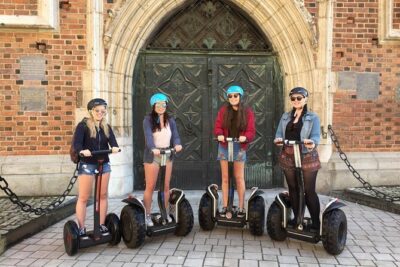
Kraków’s best-known sights are spread across a compact but busy center, and this tour links them by Segway in about four hours. You begin with basic riding practice, then roll from the Main Square and the Royal Way to Wawel Castle before crossing into Kazimierz, the old Jewish district.
I like the large sweep of the route, which covers royal Kraków, churches, medieval defenses, Jewish heritage, and modern local life in one outing. I also like the balance of famous places and smaller corners, such as Kanonicza Street, the Papal Window, and the courtyard of Collegium Maius.
The main drawback is the pace. With around 23 stops and a group of up to 25 people, many visits are short story stops rather than long explorations. You also need decent weather, and the $98.18 price is best justified if you value a broad overview and lively guiding.
Key points at a glance
- A four-hour route with 23 stops: You cover both Kraków’s Old Town and Kazimierz without spending the whole day on foot.
- A short Segway lesson comes first: At Wiślna 4, you learn how to turn and stop before setting off.
- Rudolf is a memorable guide option: His humor, warmth, acting, and strong command of local history were singled out in the available feedback.
- The route mixes major sights with local stories: Expect Wawel Castle, St. Mary’s Basilica, the Barbican, synagogues, legends, and film history.
- New Square adds a food stop: Zapiekanki, Poland’s popular open-faced fast food, is available to buy, but food is not included.
- You return to the starting point: The tour begins and ends at Wiślna 4, near public transportation.
Why a Segway works well in Kraków
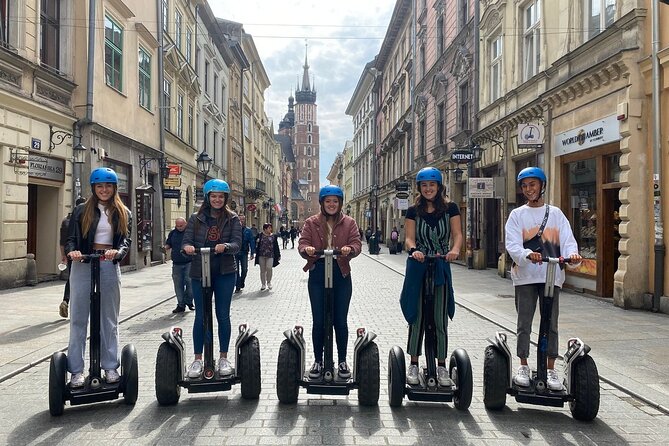
Kraków rewards walking, but the center can feel like a lot of ground when you want to see both the Old Town and Kazimierz in one morning or afternoon. A Segway gives you a practical middle ground: you move faster than on foot, but you remain outside at street level and close to the buildings.
That matters here. The route is not just a list of distant viewpoints. It takes you through squares, old streets, church fronts, castle approaches, former defensive areas, and Jewish quarter streets. You can look around as you move, then stop for a short explanation.
You should not expect a private guide experience. The maximum group size is 25, which is fairly large for a vehicle-based city tour. Your experience will depend partly on the group’s riding confidence and on how well you can hear the guide at busy stops.
More Old Town Segway Tours in Poland
- Krakow: Old Town Guided Segway Tour
★ 4.7 · 756 reviews - Krakow Old Town Segway Tour 2hr with Training, Safety Gear, Guide
★ 5.0 · 435 reviews - Krakow: Jewish Quarter Segway Tour
★ 4.8 · 271 reviews
Starting at Wiślna 4 and learning the controls
The first stop is at Wiślna 4, where you receive your helmet and complete a Segway training session. The lesson covers how to turn and stop correctly, and it takes about 10 minutes.
This short introduction is important even if you have used a Segway before. You need to feel comfortable controlling your speed and direction before reaching busy streets and public squares. The included helmet is a useful basic safety feature.
The tour returns to Wiślna 4 at the end, so you do not need to arrange a second pickup point. The meeting place is near public transportation, which makes the start and finish fairly simple to fit into a day in Kraków.
Kraków’s Main Square and the Royal Way
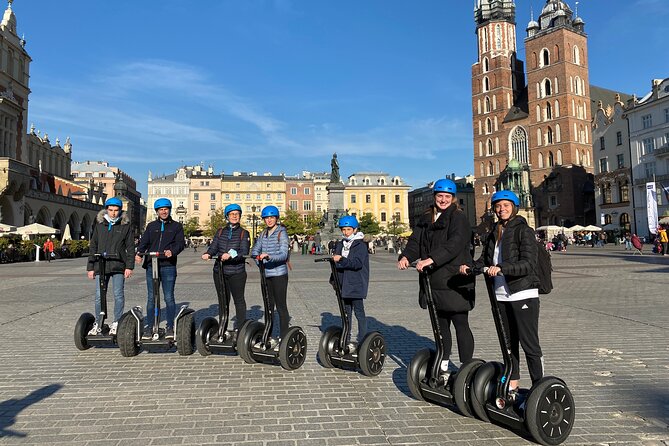
The first major sightseeing stop is Rynek Główny, Kraków’s enormous central square. The guide explains the square and its surrounding buildings, with special attention to St. Mary’s Basilica and the Cloth Hall.
This is where the tour’s storytelling style begins to matter. The square is easy to photograph, but its legends give it more character. You hear stories connected with St. Mary’s Church and the Cloth Hall instead of simply passing them as old buildings.
From here, the route follows the Royal Way, known in Polish as Droga Królewska. The guide explains why this road received its royal name. It is a useful piece of context, since the route connects the central city with Wawel and helps you understand how Kraków’s ceremonial and political center was arranged.
The stop at the Church of St. Peter and St. Paul adds one of Kraków’s most striking church facades. The focus is on the church’s story and design. You should treat this as an exterior-focused introduction unless the guide specifically arranges time to go inside.
Kanonicza Street, Wawel Castle, and the dragon
Kanonicza Street is presented as Kraków’s oldest street. Its narrow, historic setting gives you a break from the broad scale of the Main Square, and it helps show how the city changes from grand civic spaces to intimate lanes.
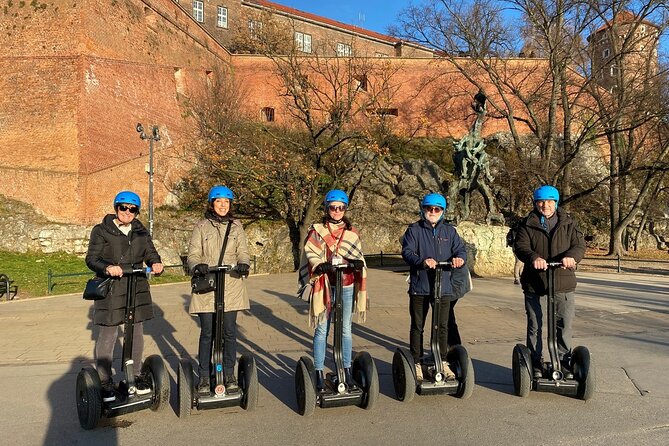
Next comes Wawel Royal Castle, the major royal stop on the route. The guide tells you about Poland’s kings and queens and explains the importance of the castle. Since the tour is built around short stops, this is more of a cultural introduction than a full castle visit. If you want the castle interiors, separate admission and additional time would be necessary.
Near Wawel, the route reaches the Monument of the Wawel Dragon. The dragon legend is one of Kraków’s most popular stories, especially for families. It also gives the tour a lighter moment after the royal material. Children usually connect quickly with the tale, while adults get a memorable piece of local folklore.
More Old Town Segway Tours in Krakow:
- Segway Tour of Krakow: Full Tour (Old Town + Jewish Quarter) – 3-Hours of Magic!
★ 5.0 · 152 reviews - Segway Tour Krakow: Jewish Quarter Kazimierz- 2-Hours of Magic!
★ 5.0 · 125 reviews - 120 min Old Town Segway Tour in Krakow
★ 5.0 · 92 reviews - Krakow Old Town Segway Tour — 2H of History, Fun & Discovery
★ 4.8 · 91 reviews
The Papal Window and Franciscan Kraków
The Okno Papieskie, or Papal Window, is named for its connection with the pope. The guide explains why the window has that name and adds related stories.
Nearby Plac Franciszkański and the Franciscan Basilica bring in another layer of Kraków’s religious and civic identity. You hear facts and local legends about the square, then learn about the Basilica of St. Francis of Assisi.
These stops are useful because they show that Kraków is not only a medieval royal center. Churches, public squares, religious orders, and modern Polish memory all overlap in this part of the city. The short format lets you connect the locations, though it does not leave much time for a quiet interior visit.
Collegium Maius and the city beyond the postcard
At the Jagiellonian University’s Collegium Maius, you see a peaceful academic courtyard associated with scholars such as Nicolaus Copernicus. The moving figures on the clock are a detail worth watching for.
This stop changes the tone of the tour. After castles, legends, and basilicas, you get a glimpse of Kraków as a university city. The courtyard also offers a calmer setting, although a 10-minute stop can pass quickly if the group is large.
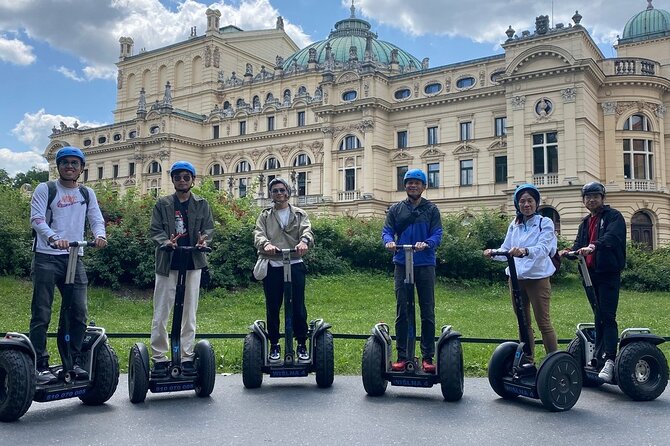
Szczepański Square follows, with stories about its past and the former Helena Modrzejewska Theater. This is a good example of the route’s broader aim: not every stop is one of Kraków’s headline sights, but several help you see how public spaces evolved over time.
Medieval defenses at the Barbican and St. Florian’s Gate
The Barbican, now connected with the Museum of Kraków, introduces the city’s defensive system. The guide explains how Kraków was protected and how the city changed during and after the partitions of Poland.
St. Florian’s Gate is described as the last remaining fragment of the old city wall. You learn what happened to the wall and what can be found on the inner side of the surviving section.
Together, these stops make sense as a pair. The Barbican shows the outer defense, while St. Florian’s Gate gives you a more direct look at what remains of the wall system. If you enjoy military history or urban design, pay close attention here.
The route then returns to St. Mary’s Basilica, this time with stories about its two towers of different heights and other local legends. That detail is easy to notice, but the explanation gives it a stronger place in the city’s story.
Crossing into Kazimierz
The second half of the tour moves into Kazimierz, Kraków’s historic Jewish district. The first major stop is the Tempel Synagogue, where the guide discusses the Jewish community that lived and worshipped in the area before the Second World War.
The Jewish Community Centre of Krakow, known as JCC Krakow, provides a link between the district’s past and its present. Since opening in 2008, it has served as a welcoming center for Jewish life, tradition, and modern culture.
This part of the route deserves respectful attention. Kazimierz is not only a film setting or a collection of old religious buildings. The tour connects the district’s prewar community with the continuing presence of Jewish life today.
New Square and Kraków’s favorite fast food
At Market Square, known locally as Plac Nowy or New Square, you get a more everyday view of Kazimierz. The guide introduces the square, points you toward local life, and recommends trying zapiekanki.
Zapiekanka is Poland’s open-faced fast food, usually served as a long piece of bread with toppings. It is not included in the tour price, so bring extra money if you want to try one. This is one of the few chances during the outing to pause for something edible, and it makes a useful snack rather than a full meal.
The stop also helps balance the heavier historical material. You are not only hearing about the past. You are seeing a place where people meet, eat, and spend time now.
Schindler’s List and the synagogues of Kazimierz
The Schindler’s List Passage adds film history and documentary context. The guide discusses the movie, related documentaries, and facts connected with the area.
You then visit the Old Synagogue, one of Kazimierz’s key Jewish landmarks. The route continues to Remuh Synagogue, where the guide explains its history. If you wish, you can visit the synagogue and cemetery as well, but admission and extra time should be treated separately from the included guiding and helmet.
These stops are best approached as an introduction. A 10-minute explanation at each place cannot replace a dedicated museum visit or a careful personal exploration. Still, the route gives you enough background to decide which sites deserve more of your Kraków time.
Corpus Christi Church and the ride back
The final major stop is Corpus Christi Church. The guide explains the origin of its name and the history of the church. You can also visit this distinctive interior if time and access allow.
This church provides a fitting contrast with Kazimierz’s synagogues. Within a short ride, you have encountered several religious traditions and the changing character of the district. The tour then returns to Wiślna 4, where the activity ends.
The published timing lists many stops at about 10 minutes each, with the Main Square receiving around 20 minutes. Since the complete route is described as approximately four hours, the actual time at individual locations may vary with traffic, riding conditions, group size, and the guide’s storytelling.
The guide makes the difference
The strongest praise in the available feedback focuses on guiding, especially Rudolf. He is described as warm, humorous, committed, and highly informed about history, with acting ability that brought extra laughs to the day.
That tells you what this tour is trying to do well. It is not simply a moving checklist of buildings. The guide uses legends, historical explanation, humor, and performance to keep the route lively.
The tone may not suit you if you want a quiet, scholarly walk with long periods inside museums. It should suit you if you like history delivered in plain language, with stories that help you remember places after the tour ends.
Is $98.18 a fair price?
At $98.18 per person, this is not a budget sightseeing option. You are paying for the Segway, helmet, training, guide, and a four-hour route that links two major parts of Kraków.
The value is strongest if you have limited time and want a broad first look at the city. Covering the Main Square, Wawel, the medieval defenses, and Kazimierz on foot would take more energy and careful planning. The Segway lets you see the connections between them.
The value is weaker if you mainly want long visits inside churches, synagogues, or museums. Food and drinks are not included, and the many short stops mean you may still want separate visits afterward. The tour is best seen as a wide introduction, not a replacement for detailed site visits.
The cancellation terms are practical but firm. You receive a full refund if you cancel at least 24 hours before the start time. Changes or cancellations within 24 hours are not refunded, and poor weather can lead to a new date or full refund.
Who should book this Kraków tour?
I would choose this for a first visit, a short stay, or a family that wants to cover a lot without a long walking day. The dragon legend, moving clock figures, royal stories, and zapiekanki stop give younger visitors several points of interest.
It also suits anyone who enjoys city history in a social, entertaining format. Rudolf’s style, if he leads your outing, sounds especially well matched to people who appreciate humor and theatrical storytelling.
I would think twice if you dislike group activities, feel uneasy on a Segway, or want an unhurried visit to every religious site. The group can reach 25 people, and the pace is designed for coverage rather than extended contemplation.
Should you book it?
Book this tour if you want one active outing that connects Kraków’s main square, royal center, medieval walls, churches, and Kazimierz. The broad route and strong storytelling give you useful bearings for the rest of your stay.
Skip it if your priority is slow museum time or a small private experience. At $98.18, the tour earns its price through range, transport, and guiding, not through included food or long admissions. For many first-time visitors, that trade can work well, especially when good weather and a lively guide such as Rudolf are part of the day.
FAQ
Where does the Kraków Segway tour begin?
The tour begins at Wiślna 4, 33-332 Kraków, Poland.
Where does the tour end?
The activity ends back at the meeting point on Wiślna 4.
How long does the tour last?
The tour lasts approximately four hours.
Is Segway training included?
Yes. The tour includes a training session covering how to turn and stop correctly. The training takes about 10 minutes.
Is a helmet included?
Yes. A helmet is included in the tour.
Are food and drinks included?
No. Food and drinks are not included. You can buy zapiekanki at New Square if you want to try this Polish fast food.
What happens if the weather is poor?
The experience requires good weather. If it is canceled because of poor weather, you are offered a different date or a full refund. You can also cancel at least 24 hours before the start time for a full refund.
Just added for riders around Krakow
- Krakow: 2h World War II, visiting the Ghetto segway tour★ 5.0 · 2 reviews
- Offroad Segway Guided Krakow City Tour★ 5.0 · 35 reviews
- Jewish Quarter (Kazimierz) Segway Tour in Krakow★ 5.0 · 14 reviews
- Segway Rental 30 min, 60 min or 120 min in Krakow★ 4.5 · 8 reviews
- Krakow: 30min Segway Rental with Helmet and a photosession★ 5.0 · 3 reviews
- Krakow: Old Town & Jewish Quarter 2-Hour Segway Tour★ 5.0 · 2 reviews
- Krakow: Royal Route Segway Tour 1 hour★ 4.8 · 3 reviews
- Segway Tour Krakow: Grand Tour (Old Town + Wawel Castle)★ 5.0 · 10 reviews
Old Town Segway Tours in Poland: how they compare.

Krakow Old Town Segway Tour 2hr with Training, Safety Gear, Guide
Read our review →
Warsaw Old Town 1.5-Hour or Full 3-Hour Segway Tour
Read our review →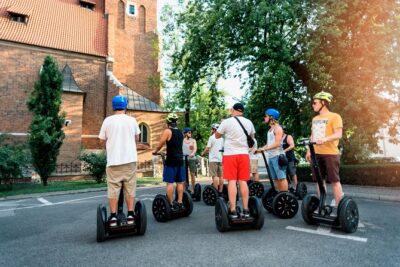
Segway Tour of Krakow: Full Tour (Old Town + Jewish Quarter) – 3-Hours of Magic!
Read our review →
Segway Tour Krakow: Jewish Quarter Kazimierz- 2-Hours of Magic!
Read our review →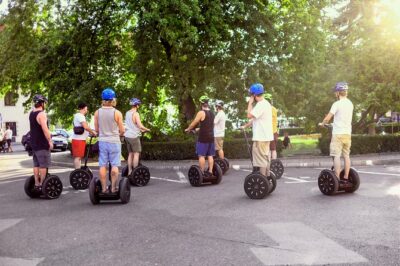
Segway Tour Warsaw: Old Town Tour – 1,5-Hour of Magic!
Read our review →