
Review · GERMANY
Dortmund Soccer Segway Tour
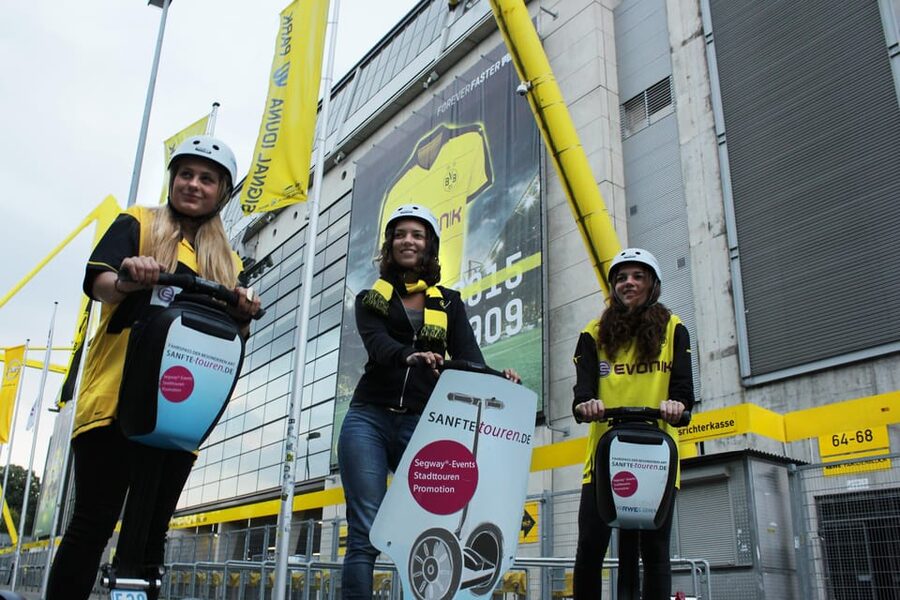
Dortmund’s football story began at Borsigplatz in 1909, and this two-hour Segway ride links that founding place with Signal Iduna Park, Rote Erde Stadium, and several less obvious city stops. You get a moving lesson in Borussia Dortmund’s past rather than a stadium visit alone.
I like the small group limit of eight, which should make it easier to hear the guide and get help on tricky stretches. I also like the mix of football and city history, from the old Restaurant Zur Sonne to the grave of founder Franz Jacobi at the Southwest Cemetery.
The main consideration is simple: this is a German-language tour, and you must weigh between 45 and 118 kilograms and be at least 14 years old. If you have never used a Segway, allow time for the briefing and practice before the route begins.
Key points to know before you book
- Borsigplatz tells the 1909 origin story: This is the founding place of Dortmund’s football club and one of the tour’s most important stops.
- The route connects both major stadiums: You visit Signal Iduna Park and Rote Erde Stadium from outside as part of the ride.
- A headset keeps the history audible: You receive an audio receiver so you can listen while moving with the group.
- The route has more than football: Westpark, Sonnenstraße, the Southwest Cemetery, and Trinity Church add city context.
- Beginner riders are welcome with limits: The briefing is designed to get first-time riders moving, but the activity still requires balance and mobility.
- Eight people is the maximum: This keeps the experience more personal than a large sightseeing group.
Why this tour is different from a stadium visit
If you only want to see Signal Iduna Park, a stadium-focused activity may be more direct. This tour gives you a wider picture. You trace the club’s beginnings, ride through parts of Dortmund, and connect football landmarks with places tied to the people who helped build the club.
That matters because football in Dortmund is not confined to a modern arena. The tour begins with older city settings and follows the story toward the stadium district. You see where the club was founded, where supporters and promotion work developed, and where its founder is remembered.
The Segway changes the pace. You cover more ground than you would on foot, but you still move slowly enough to hear the guide and take in the route. It is also a more playful way to see Dortmund. You are not simply standing at a stop while someone talks. You are learning between stops, with the ride itself forming part of the outing.
The experience costs about $93 per person. That is not a cheap city ride, so the value depends on what you want. For a Borussia Dortmund supporter, the price pays for a focused two-hour route, a local guide, equipment, and access to several football-related places in one outing. For a general visitor who has little interest in football, the value is weaker, though the city history gives the tour broader appeal.
Other segway rides we rate around Germany
- Dresden: Segway Tour Along the Elbe and Old Town
★ 4.9 · 392 reviews - Heidelberg: Philosophers’ Walk Guided Segway Tour
★ 4.8 · 322 reviews - Munich: City Highlights Guided Segway Tour
★ 4.6 · 266 reviews
Getting started at the U
The experience begins at the listed meeting point, Im Defdahl 12, 44141 Dortmund. The route then starts with the guide at the U, the city’s well-known cultural landmark. Since the meeting-point details and route-start wording are both provided, check the exact joining instructions when you reserve and give yourself a little extra time.
Before you ride, you receive a safety briefing. You put on a helmet and safety vest, then collect the audio receiver and headset. This is important for first-time riders. Segways can feel unusual during the first few minutes, and the briefing gives you a chance to learn the controls before dealing with the full route.
Past participants specifically praised the introduction for beginners. That does not mean you can skip the safety advice. You still need to remain comfortable on the machine, follow the guide, and manage changes in the route. The guide helps on difficult sections, but you should expect to take an active part in controlling the Segway.
Wear comfortable shoes. You do not need special footwear, but you will be standing and riding for around two hours, so soft, secure shoes make more sense than dress shoes or loose sandals.
Westpark and Sonnenstraße: the city before the stadiums
The route crosses Westpark before continuing along Lindemannstraße toward Sonnenstraße. This early section helps you see Dortmund as a city rather than just a football destination.
At Sonnenstraße, the route passes Restaurant Zur Sonne. The place has a connection with the club’s fan and promotion department, giving the guide a chance to explain how football support developed beyond the pitch. It is a small detail, but it helps fill out the story. Clubs grow through supporters, organizers, and local meeting places as much as through matches.
The audio system is useful here. You can keep your eyes on the road while listening to the guide, instead of stopping every few minutes to form a tight circle around the speaker. In a group of up to eight, you should also have a reasonable chance of hearing clearly, though traffic and city noise can still affect how well you catch every word.
This part of the route may appeal most to visitors who want a little Dortmund context. If you came only for stadium photos, it might feel like a detour. If you like understanding how a club fits into its home city, it gives the tour more substance.
Franz Jacobi’s grave at the Southwest Cemetery
The ride continues to the Southwest Cemetery, where Franz Jacobi has been the final resting place since 2013. Jacobi is identified with the founding of Dortmund’s football club, so this stop gives the origin story a personal focus.
A cemetery stop can sound less exciting than a stadium, but it adds something that a standard sports tour often misses. You are reminded that the club’s early years came from real people and local effort, not just from a famous name and a large arena.
The stop also changes the mood of the tour. The route is light and active, but this is a quieter point for listening. You may value it if you enjoy the human side of sports history. If your group is looking for nonstop riding and big sights, it may feel more reflective than expected.
The guide’s role matters here. Guides associated with this experience include Daniel, Wolfgang, and Stefan, and the strongest feedback about them centers on enthusiasm, patience, and clear explanations. Names can change with the date of your booking, so do not assume a particular guide will lead your departure. What you can expect is a live German-speaking guide rather than a recorded route with no personal help.
Same streets, another route to glide:
- Berlin 2-Hour Segway Tour
★ 4.6 · 238 reviews - Heidelberg & Neckar Valley: Segway Tour – 360 Degrees
★ 4.8 · 227 reviews - Munich 3-Hour Segway Tour: Nazi Munich & Royal Architecture
★ 4.9 · 194 reviews - Heidelberg Highlights Segway Tour with Castle
★ 4.8 · 191 reviews
Strobelallee and Dortmund’s two stadiums
From the cemetery, the tour heads via Strobelallee toward the stadiums. This is the section most football fans will anticipate.
You visit Signal Iduna Park, Borussia Dortmund’s major stadium, along with Rote Erde Stadium. Seeing both matters because they represent different parts of Dortmund’s football identity. Signal Iduna Park is the modern, high-profile home that draws attention from around the world. Rote Erde provides a link to the city’s older sporting setting.
The supplied details do not promise a stadium interior visit, match tickets, or an exclusive behind-the-scenes tour. Treat this as an exterior route with explanations, not as entry to the stands or changing rooms. If you need to go inside Signal Iduna Park, check for a separate stadium tour.
The Segway works well around a stadium district because you can approach several nearby points without spending the whole outing walking between them. You should still expect a sightseeing ride, not a racing course. The group follows the guide, and safety remains more important than speed.
This is also where the headset earns its keep. You can look at the stadiums while hearing the story, rather than choosing between watching the guide and watching the buildings. The guide can point out details as you move, though your view may depend on the exact conditions on the day.
Borsigplatz, where the club story begins
The route then heads north toward Borsigplatz, described as the founding place of the Dortmunder Soccer Club. For many people, this is the most meaningful stop because it takes you away from the famous stadium and back to the club’s beginning.
Borsigplatz gives the football story a sense of place. The club did not start as a giant institution with a huge ground and international attention. Its story began in an urban neighborhood, among local people and early organizers. A guide can make that change in scale clear: from a modest founding point to one of Germany’s best-known football clubs.
The route also includes Trinity Church. This adds another layer to the area and keeps the stop from feeling like a single-photo pause. You get a place tied to the club’s origin alongside a local landmark with its own presence.
I would pay close attention here, even if you are not a devoted supporter. Borsigplatz is the kind of stop that gives a city tour its character. Signal Iduna Park is the obvious attraction, but the founding place explains why Dortmund’s football story belongs to the city itself.
How beginner-friendly is the Segway ride?
The experience is suitable for first-time Segway riders, provided you meet the age and weight rules. Several people who had never ridden before found the instruction clear and managed the route with help from the guide.
That does not make the activity effortless. You must stand for the full ride, keep your balance, and respond to the controls. The guide may help on difficult sections, but no tour can remove the need for basic coordination.
The age minimum is 14. Children under 14 cannot join, and the listed weight range is 45 to 118 kilograms, or 99 to 260 pounds. Anyone above 118 kilograms is not eligible. These are firm planning points, not minor conditions to sort out at the meeting point.
A helmet and safety vest are included. The headset is also included, so you do not need to bring listening equipment. Comfortable shoes are the main item to pack.
Guide quality and the German-only format
The guide is central to this experience. The route includes many stops, but the meaning comes from the explanations: the club’s 1909 beginning, the role of Restaurant Zur Sonne, Franz Jacobi, the stadium district, and Borsigplatz.
The named guides connected with the experience include Daniel, Wolfgang, and Stefan. The strongest personal qualities associated with the guiding are enthusiasm, friendliness, patience, and a willingness to help when a rider finds a section difficult. That combination matters more on a Segway tour than on a standard walking route because the guide must manage both the story and the group’s movement.
The live guide speaks German. There is no English guide listed, and the audio system does not change the language. If you understand German, the headset should make it easier to follow while riding. If you do not, you may still enjoy the route and the sights, but you will miss much of the football and city history.
Ask yourself how much of the tour’s value depends on the explanations. For me, the answer is a lot. The stadiums and Borsigplatz are worth seeing, but the connections between them are what make this more than a two-hour ride.
Group size, timing, and overall value
The tour lasts two hours and limits the group to eight participants. That is a useful balance. You get the energy of a shared outing without the long line and scattered listening that can come with a large group.
Two hours is enough for a focused introduction to Dortmund’s football story. It is not enough for a full city tour, an in-depth club archive, and an indoor stadium visit. Think of it as a compact route with several well-chosen stops.
At $93 per person, the experience is best value for a football fan, a couple looking for an active city activity, or a small group that wants a local guide. The price includes the helmet and headset, but not a stadium interior visit or a meal. You are paying for the guide’s route, the equipment, the small-group format, and the chance to cover several places without walking the entire distance.
Free cancellation is available up to 24 hours before the activity for a full refund, and you can reserve now and pay later. Those policies help if your Dortmund schedule is still changing, but the practical details remain the same: verify the start time, arrive at the stated meeting point, and make sure everyone meets the age and weight requirements.
Should you book the Dortmund Soccer Segway Tour?
Book it if you want football history with movement, not just a stadium photo. It is especially well suited to Borussia Dortmund supporters, first-time Segway riders, and visitors who enjoy hearing local stories while seeing several parts of a city.
Think twice if you need an English-language tour, cannot ride within the 45 to 118 kilogram range, or want access inside Signal Iduna Park. You should also choose another activity if standing on a Segway for two hours would be uncomfortable.
For the right person, the tour offers a lively route from the club’s 1909 beginnings at Borsigplatz to the major stadiums of today. The small group, helpful instruction, and personal guide make the $93 easier to justify, while the German-only format and exterior stadium focus are the two points to check before paying.
FAQ
Where does the Dortmund Soccer Segway Tour meet?
The listed meeting point is Im Defdahl 12, 44141 Dortmund. The route begins with the guide at the U, so check the exact joining instructions and starting time when you book.
How long does the tour last?
The tour lasts two hours.
What language does the guide speak?
The live tour guide speaks German. Headsets are provided so you can hear the guide clearly while riding.
Which football places does the tour visit?
The route includes Signal Iduna Park, Rote Erde Stadium, Borsigplatz, and the Goldsaal. It also passes places connected with Dortmund’s football and city history, including Restaurant Zur Sonne, the Southwest Cemetery, and Trinity Church.
Can beginners ride the Segway?
Yes. The activity includes a safety briefing, and the tour is suitable for people who have not ridden a Segway before, provided they meet the age, weight, and other participation requirements.
What are the age and weight limits?
All participants must be at least 14 years old and weigh between 45 and 118 kilograms, or 99 and 260 pounds. Children under 14 and people over 118 kilograms cannot take part.
Just added for riders around Germany
- Munich Third Reich and WWII Segway Tour★ 4.5 · 20 reviews
- Munich 2-Hour Segway Tour★ 5.0 · 15 reviews
- Segway tour Munich Beer Stories (3h)★ 5.0 · 3 reviews
- Beer Testing Segway Tour in Munich★ 3.5 · 2 reviews
- Munich’s Highlights 3-hour Segway Tour★ 5.0 · 76 reviews
- Segway Tour Munich Old Town 3 hours★ 4.5 · 10 reviews
- Munich Classic City Segway Tour (English or German Guide)★ 5.0 · 65 reviews
- 2-Hour Segway Discovery Munich Night Tour★ 5.0 · 2 reviews
Germany Segway Tours: how they compare.
Dresden: Segway Tour Along the Elbe and Old Town
Read our review →
Heidelberg: Philosophers’ Walk Guided Segway Tour
Read our review →
Heidelberg & Neckar Valley: Segway Tour – 360 Degrees
Read our review →
Munich 3-Hour Segway Tour: Nazi Munich & Royal Architecture
Read our review →
Find this segway ride in